top of page
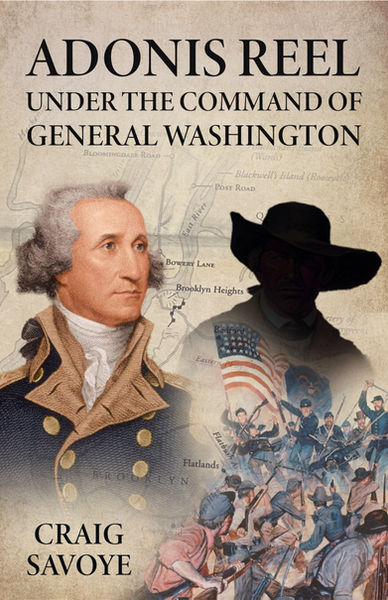
AdonisReelCover.jpg

​

                        NOTES ON TEXT

                     and 

                SOURCES


Publisher’s Note

            The reader can well imagine my concerns about sullying George Washington’s reputation. My fictitious Publisher’s Note captures the historical truth and my approach: Washington had virtually no intelligence capacity in New York in 1776 (which created an ideal vacuum for my fiction), nor any experience in that regard, it being the first battle of the war in which he participated, much less commanded. He had proven himself on the battlefield in the French and Indian War, but the ‘battlefield’ then was essentially guerilla-type warfare, not European style massed, linear musket volleys. Just as Washington had to teach himself the latter, he also had to learn the espionage business. American and British forces in the French and Indian War no doubt employed scouts and informants from friendly tribes to gain tactical intelligence on their foes, but the kind of ‘urban’ espionage His Excellency later practiced with the Culper Ring, and fictionally engages in with Adonis in my story, would have been new to him. 

            In real life I don’t have a ‘gotcha’ mentality; that is, I’d rather identify a problem (cause) and focus on finding a solution rather than point fingers and assign blame for effect. I hope no reader is offended by how I portray Washington. His failures at the Battle of Brooklyn were many, but he learned from his mistakes and went on to win the war against enormous odds. The latter cannot be argued and my respect for him is enormous. From my perspective, his early failures do nothing to diminish his standing in history. Unfortunately, the narrowly circumscribed timeframe of my book is also the period of those early failures.

            If, rather than a novel, this book had actually been written in the 1780s, would Washington have quashed publication because of its somewhat negative portrayal of him? Possibly. Ketchum [36] writes about Washington’s concern for his reputation in letters to his brothers.

In terms of overall narrative legitimacy, many of the techniques Adonis employs (such as the passing of false intelligence), did indeed occur, just later in the war. 


Bunker(’s) Hill      

            For the most part I stayed true to the history of the battle, slipping Adonis into the fight with preternaturally perfect timing. Howe’s first charge on the flats occurred around 3 p.m., and the final assault on the redoubt around 3:30. I mention no clock time in the text, but if Adonis crossed the neck around 2:45 and the made it down to the beach by 3:00, then his subsequent fictional migration up to the redoubt on Breed’s Hill would have synced with the real time of the battle.  

            I felt compelled to include the quote “Never was more confusion and less command” since (in my opinion) it perfectly captured, in a contemporary quote and contemporary language, the essence of the disarray on the American side that day. Philbrick [199] includes the quote, which is from a letter penned by John Pitts, a member of the Massachusetts Provincial Congress, to Samuel Adams following the battle.  

           Much debate surrounds the origin of the quotation: “Don’t shoot until you see the whites of their eyes.” Virtually all historians agree it originated at Bunker Hill, but who said it is an open question. The leading choice and most logical one is Colonel Prescott because he was on the front line and low on ammunition and so urged his men to hold their fire until it would be undoubtedly effective. I chose not to use the line because I thought anyone unfamiliar with the origin of the phrase would think I was employing a cliché! I chose to modify it to: “Nothing exposed. I don’t want them to know how many of us there are until they get close, real close—until you can tell the blue-eyed bastards from the brown ones.”

            A student of history might well note I left Joseph Warren out of the Bunker Hill battle scene. The highly- and widely-respected Boston doctor was a more accomplished and effective politician than soldier, but when the battle broke out he left his sick bed—he apparently suffered from terrible migraines—and crossed the Charlestown peninsula neck by himself and reached the redoubt, a lone reinforcement and a veritable model for fictitious Reel. He was shot and killed during the retreat from the redoubt. In death he became hero and martyr both—and was deeply mourned. One wonders, if he had lived, if he might have earned the historical renown of an Adams or Madison. He deserved mention in the text, but it would have been a distraction since he played no critical narrative role in the battle scene as I conceived and narrowly constructed it around Adonis. 


            Allow me to explain the use of ‘Bunker’s Hill’ in the text. It wasn’t until I read the Nathaniel Philbrick book on the battle that I knew: 1. It was contemporaneously called Bunker’s Hill rather than Bunker Hill, and 2. That the battle was fought on Breed’s Hill rather than Bunker’s Hill. I debated using ‘Bunker Hill’ throughout the opening scene of the novel, but it felt inauthentic to do so.

            But…when I got to the next scene and found out it was called Brook Land in that age instead of Brooklyn, I changed my mind about using era names. I used Brook Land a couple of times in very early drafts and then abandoned it. I know that appears inconsistent (relative to Bunker Hill), but Brook Land, when used repeatedly, came off as militantlyauthentic—that is, in your face genuine—to the point of annoying the reader. Historic names can too easily disrupt narrative flow. What I mean by that in this case is:  the modern reader is forced to momentarily pause and mentally translate Brook Land to Brooklyn. Why repeatedly set down such stumbling blocks?

            So…I decided to demonstrate my authenticity chops with ‘Bunker’s Hill,’ but then switch to familiar place names throughout the rest of the book the reader would feel comfortable with. I hedged my bet in a few cases; for instance, I alternately called the Hudson River the North River and New Jersey the Jerseys. In both of those cases there was still a migration from old name to new in the late 1770s; plus, dual references are a Godsend to a writer, helping him or her avoid the plague of word repetition. 


            I enjoyed every aspect of researching and writing Adonis, but I am not a military historian fanboy. I have no interest in clinically accurate descriptions of military equipment, nomenclature, or tactics. Indeed, I feared a close description of the workings of a musket or a cannon would lose the average reader. Yet it is important for the reader to understand the cumbersome process of loading a musket (and even more burdensome process of loading a rifle) so that they grasp the nature of warfare in that era. An ideal example is two sides firing at close range, and then one side attacking the other with bayonets before the other has time to reload. Thus, I try to work in brief descriptions of the loading and firing of various armaments, to establish credibility, but I purposely avoid disrupting the story flow with specifics. 


April 13

            Colonial laws varied by region, but oyster season generally ran from September 1 to March 1. The timetable-puzzle-pieces of my narrative required that the oyster season end June 20, so I arbitrarily extended the oystering season on Long Island by six weeks.

            Ernest Ingersoll’s definitive history of the oyster industry in America, published in 1881, leaves the impression that, prior to seeding in the 19th century, there were no natural oyster beds in Jamaica Bay and west, including Gravesend Bay and presumably Gowanus Creek and tidal marsh. But he also cites a letter by a Dutch visitor to the area in 1679 who said Gowanus oysters “are the best in the country” and writes of “great quantities of them.” Since there was no seeding in those days, obviously these “best” bivalves came from natural beds—at least that interpretation worked to my narrative advantage. I thus created a reality in which there were some natural beds at Gowanus in 1776, but not an “industry”—as was the case at Rockaway.


            A minor item, but in Adonis’ musing about his past, he mentions becoming an orphan along with Martha at age 16 (him) and that they were placed in a workhouse. But such orphanages generally attempted to apprentice their charges by that age, thus ending their residence in the workhouse.


            Adonis supplying Ebenezer Swain with oysters, even as fiction, is totally inaccurate. There was a healthy, if not thriving, Staten Island oyster ‘industry’ in 1776, but I needed to create a link between Adonis the oysterman and Staten Island. In ‘reality,’ Eb could have gotten all the oysters he wanted not far beyond his front door; he certainly would not have needed a supplier from Long Island.


            Washington’s headquarters in the summer of 1776 was in the Richmond Hill estate of the late British officer Abraham Mortier, although the home itself was known as Mortimer House. Washington stayed at Number One Broadway, in the Kennedy mansion, for only a few days until Mortimer House, near Greenwich village, was made ready. The Kennedy House remained a main operations center, but it was far easier for me, in a narrative sense, to make it General Washington’s headquarters, so I did. 


April 28

            In this scene the description of Brooklyn village is derived chiefly from Johnston [24-25]. The anecdote about the white oak that Adonis uses to navigate while racing back through the woods to confront the highwaymen is from the diary of Lt. James Moody [38].


May 23

            Blivin, Schecter, and Johnston were all helpful in my attempt to conjure a Manhattan street scene on this date.


June 27  

            Any writer knows how important it is to have alternate references when repeatedly naming a character in a scene. For Washington, I rotated between Washington, General, commander in chief, His Excellency, and even, occasionally, the Virginian. I was desperate for a second reference for General Howe. I used just plain ‘General’ a few times, but never when Howe was being discussed in the presence of General Washington, and in the many scenes on Staten Island with Howe, the designation was a bit confusing since Blydenburgh was almost always present and also a (brigadier) general. 

            So, I resorted to ‘Sir William’—but it was a premature knighting. Howe did not become a Sir until after the Battle of Brooklyn and because of the battle, which was widely perceived in London as a decisive victory. Ironically, history shows that by not attacking the inner defense prior to Washington’s overnight retreat across the East River and thereby crushing the Continental Army in its infancy, Howe may have been knighted for precipitating events that eventually lost Britain the long war. 


            For some reason I wanted Joseph Reed, Washington’s aide-de-camp and Adjutant General—and a lawyer by profession—to appear more like a civilian advisor than a military one. routinely dressed Reed in a civilian suit, but it’s almost certainly the case he was adorned in a military uniform like virtually everyone else in Washington’s headquarters coterie. (I think my thinking was simply to create a contrast between suit and uniform, to perhaps give Reed a bit of civilian gravitas rather than picture him the way I do uniformed Howe aide Blydenburgh—as a flunky.) Howe’s private secretary was Ambrose Serle. I chose not to use his real persona because he is so well known for his published account of the war. I wanted a blank slate; Blydenburgh is entirely fictitious.


July 3

            I’d never heard of Fatty Van Vorst before beginning research on Adonis. He is a very minor historical figure, but yes, he is real and owned a ferry and racetrack, etc. at Paulus Hook. The first time I read his name—the moment I saw his name—I knew I had to turn him into a character in the book. Relish is fictitious.


July 5

            I made up the use of royal succession as a code by rotating British pickets. The narrative essentially forced me to repeatedly reference such watchwords and countersigns, but they are a minor, if not distracting element in the story, so I didn’t want to over emphasize them by creating a complicated code. Royal succession was not only a fun and lucid way to handle the issue, but also enlivened the storytelling when Reel, under pressure, had to recall the correct Royal in the heat of the Staten Island kidnap operation. 


July 9  

            In my research I read several times (scant references) about an incident in which British soldiers were captured near the Narrows, or on Staten Island, around this time, and interrogated with the gain of limited intelligence. I formulated the operation to capture five British soldiers on Staten Island based on those brief mentions. As it does to Adonis, the op seemed like an ill-conceived mission to me, yet just the kind of minor historical occurence I might morph into an exciting scene. I had essentially written the chapter when I dug a bit deeper and found out the “captured” soldiers had essentially run into a Continental patrol on Long Island near the Narrows. There had been no “operation” to bag them. No problem. Fiction, like the show, must go on.


            The scene setting in and around the Common for the reading of the Declaration of Independence derives from Blivens [Under 348-354].


            The scene setting in and around Bowling Green for the toppling of the King George III statue derives from RKetchum [26-27].


July 30

            Here’s a conundrum for a historical fiction writer—at least one where the conceit is the manuscript isn’t just about 1776, it was also supposedly written in that age: there were no envelopes in 1776. Pages were folded over and sealed with wax or sometimes not sealed at all. My conundrum: how to explain the lack of envelopes to the modern reader when the “author,” writing in the 1780s, has never heard of them and thus cannot do so. Hopefully Adonis readers, reading about folded over paper sealed with wax, will intuit the lack of envelopes in that day. 


July 31

            A careful reader might note a discrepancy in this scene. When I first drafted it, I thought Trinity Church—the front door—faced south. Thus, when Adonis is in the belfry, he hides against the north wall, the one side of the tower absent a window, since that side abuts the main edifice. But Trinity Church then, and its current incarnation, faced/face east. With the scene written and the average reader hopefully ignorant of such detail, I decided not to reorient either the church or the narrative. 


August 3

            Much of the ‘overt’ text in the secret letter is from actual Washington writings in the summer of 1776, which I glued together with some verbiage of my own. 


            There’s an interesting footnote to this scene. Yes, the American side used invisible ink (sometimes referred to by Continentals in the know as the “sympathetic stain”), as did the British, and the rebel ink was indeed a different chemical formulation than that of the British and could not be revealed by heat, milk, or other reagents of the day. Its special formulation was devised by James Jay, a physician, amateur alchemist, and brother of John Jay, the statesman and first Chief Justice of the United States. (James later switched sides and became a Loyalist.)

            The British did stage faux balls for officers, though not at Swain’s, which is a fictitious tavern.


August 9

            Clinton did indeed propose three options to Howe for deploying British and mercenary forces and attacking the Americans in the New York region [Gallagher 80]. He also recommended the flanking maneuver over Jamaica Pass, but I made up the word “twist” as a kind of shorthand that facilitated instant understanding/contextualization of the topic as it repeatedly arose (the same function a buzzword serves journalists).


August 15

           The traitor, General Burtis, is a wholly fictitious character, but not outrageously or unimaginably so because of…Benedict Arnold. Prior to becoming a turncoat, Arnold was a hero, a highly esteemed combat officer, and unquestionably patriotic. If Arnold could turn, then one of Washington’s other generals could conceivably have done so. Indeed Arnold, had he been in New York that summer rather than in the Champlain region preparing for a British invasion via Canada, would have been a member of Washington’s war council.


August 17

            I didn’t know what to do with Israel Putnam—Old Put. He was a hero in the French and Indian War, and most accounts have him coming down off Bunker’s Hill to at least reconnoiter prior to the battle, but during the charges by the British and the overrunning of the redoubt on Breed’s Hill, he did not move or direct the men under his command to do so. One American officer later charged him with cowardice that day, but there was no military tribunal or court hearing, and the veracity of the charge is not one widely accepted by historians. I’m sure there are scholars who have written papers on this, so I, who have not studied it, care not to wade into it too deeply, but I’m guessing several factors came together to explain Putnam’s inaction. 

            1. The Battle of Bunker Hill pre-dated Washington’s arrival in the Boston area, and as I mentioned in the text, no one had overall command of the various Continental militias. So, even though Putnam was the only General on Bunker’s Hill that day, he may well have thought it was beyond his authority to order reinforcements forward, or he might not have believed the order would be obeyed. (Connecticut militia generally answered to their commanding officer, New Hampshire troops to theirs, Rhode Island men to theirs, etc.)

            2. Most historians agree Prescott exceeded his limited authority that day; that is, other officers thought constructing a redoubt on Breed’s Hill was dangerously provocative and indefensible, and disagreed with the plan. Putnam was one of the dissenters. By not reinforcing, he may not have cared to—metaphorically speaking—throw good money after bad.                       Again, if Putnam disagreed with the decision to build the redoubt in the first place, and no one was in overall command, the decision not to reinforce is not necessarily evidence of cowardice; that is, there was no failure to obey an order to charge or otherwise engage. (The reader can likely tell I don’t find that a viable excuse for his passivity. The brave men in the redoubt run out of ammunition and you, the only general on the field, don’t order reinforcements to assist but rather remain at a safe distance observing?)

            3. Whereas I do not believe Old Put was a coward—indeed, if he had a strong suit, it was physical courage—I do believe he was lacking any kind of battlefield management aptitude. That becomes evident at this point in my story, when Washington questions him and General Sullivan about strategy on the eve of battle and they have none (an accurate following of the historical record). I think the same may have been true at Bunker Hill: he simply didn’t have the wherewithal to thoughtfully and effectively deploy and lead the forces he did have at his command.

            By the end of the book, if the reader sees Putnam as physically courageous, or at least brave in his dedication to duty (see his Paul Revere-like ride to lower Manhattan to alert the remaining America forces there of the British invasion and then help lead the evacuation), but also generally befuddled by anything large of scale (not a great attribute for a general), that is the impression I came away with from my research and essentially sought to reflect in the text. 

            A final note regarding my thinking on this: a biography of Putnam first published in 1788 by a sycophantic supporter seemed to cement his public reputation as a hero of two wars, but to me it is so over-the-top, his exploits described in such cartoonish fashion, it had a decidedly negative effect on my view of Old Put. Since he was either alone or an Indian captive when his heroic deeds occurred, the embellishments and vainglorious boasting in the biography must have originated, to some extent, with Putnam, no matter what narrative spangles the worshipful author added. The sensationalized accounts in The Life of Israel Putnam reminded me of a book I read while researching my previous historical novel Addison True. It’s the The Life and Adventures of James P. Beckwourth, a mountaineer who supposedly became chief of the Crow Indians. The book is written in a highly exaggerated and fanciful style and is thoroughly entertaining, but I eventually came to read it more as fiction than fact (think Hunter Thompson). I somewhat came to view The Life of Israel Putnam in the same light as Beckwourth and thus do I question Putnam’s—down to this day—overblown (my opinion) public reputation. 


August 18

            The late intelligence Washington received from Staten Island about a multi-pronged British attack is a historical fact I didn’t think I could ignore. In my research I never stumbled on a good explanation—even well after the fact, from historians—on the origin of the intelligence, which, on the surface, clearly seems to have been misinformation. I like to initially ‘set up’ anything of significance that happens later in my novels. This bit of intel, coming out of nowhere from a new source, violated my rule and muddied my narrative a bit. But again, it seemed like a snippet of history too pertinent to my espionage storyline to omit. I decided to leverage the incident by turning it into disinformation from Clinton—to help mitigate any damage his leak to Val might has caused. But that is completely my fiction. As far as I know there is no historical evidence to suggest the intelligence was planted disinformation. Who knows, it could simply have been a flight of fancy by an unreliable source rather that a determined effort to deceive. There is no historical evidence of Clinton’s involvement since I made it up. An element that works against the idea that the intelligence was disinformation is that it was indeed obtained from the Mersereaus. Father and son later became the core of a famous and effective spy ring. On the other hand, it’s also possible the Mersereaus were duped; that is, they accurately reported what they heard, but what they heard was disinformation. 


August 19

            Google AI informed me that Americans in 1776 did not bathe daily, or even once a week. Indeed, once per monthwas unusual. But I had to come up with a scheme to get the key away from the Trinity Church priest, so he became a daily bather, which I didn’t think the average modern reader would perceive as unusual.


August 26

            The conversation between Adonis and Relish in the wagon on the way to the East River in which Reel says, “If two men stand five feet apart, facing each other, both holding loaded pistols, and they’re in a dispute, and one’s a good man and one’s an evil man, the evil man always shoots first” is a riff off a bit of narrative in Walter Mosley’s Devil in a Blue Dress. 


            Gallagher [100] writes that on August 26 Washington ordered Miles and about 500 riflemen to patrol out towards Jamaica Pass. I’m not questioning Gallagher’s accuracy, but I left this out of the narrative because I didn’t see a reference to the order elsewhere in my research and it otherwise doesn’t make sense to me. Most historians agree that the outer defense on that date consisted of approximately 3000 Continental troops/militia with approximately 800 each clumped around three passes and 300 guarding the wetlands/marsh south of the end of the inner defense line.

That would leave 300 under Miles’ command guarding the rebel’s left flank. Miles had a battalion consisting of 200-400 troops, but given the high rate of sickness among Continental soldiers, 300 is probably a good guess as to Miles’ actual strength.

            Several questions thus present themselves. Where would 500 riflemen come from? Not only is 300 not 500, but it’s hard to believe Washington would order Miles to utterly abandon the positioning of the 300 in the moraine woods east of Bedford Pass—anchoring the left flank—for a foray to Jamaica Pass. And what exactly would a “patrol” do? A cavalry scout of 5-12 troops would make sense (and of course, there was a five-man scout), or if the threat of a flanking maneuver was deemed credible, then the defensive positioning of 300-500 men there would also obviously make sense. But a mobile patrol of 500 that reconnoitered the pass and then departed is just too large a force, and would not have served any legitimate purpose. Thus did I leave out of my narrative this odd quirk in the historical record. 


August 27

            The market carts that surprised Adonis on Jamaica Road the night Howe and his forces were stealing over the pass were mentioned in the research material I consulted. They struck me as a wonderful anachronism to toss into the story; their sudden appearance was dramatic and alarming. But like the narrator, or Adonis, I wonder what the drivers were thinking? They certainly had no clue 10,000 British soldiers reached the settlement around Howard’s Tavern shortly after they departed that night. But also, how did they not know additional thousands of enemy troops were about to frontally assault Brooklyn? That is, how did they not know there were entering a war zone, whether the British attacked from the south or secretly flanked through Jamaica Pass?


            General Howe did indeed initially and scornfully reject Clinton’s proposed flanking maneuver through Jamaica Pass but then changed his mind and adopted the strategy a mere twelve hours or so before the secret march commenced. Sir William’s equivocation did my storytelling a favor; that is, it not only meant Adonis could not be definitive with Washington because Howe was not definitive in his own mind (that ambiguity helped build dramatic tension between Adonis and Washington), but it also led to Reel’s culminating overnight quest to determine if Howe was indeed leading a force over the pass—and that pursuit is at the heart of the climactic battle scene. 


            I mashed together several elements of the historical record in the scene that occurs around Howard House. Several loyalists helped secretly guide Howe and his 10,000-man flanking force across the flatlands of southwestern Long Island to Jamaica Pass. Once there, William Howard, the owner of the tavern, and his family were awakened. Howard was a patriot, but under the threat of death and with his family at risk, he agreed to lead Howe via a back path to the pass so that Howe could determine if it was guarded. I essentially wrapped up all of that “guide” activity into one person: fictitious Rem Wedderburn. 


            According to the historical record, Colonel Miles did in fact move east toward Howe’s large flanking force, but it wasn’t due to intelligence provided by a spy such as Adonis Reel. Miles offers an extensive explanation of his actions in his journal, a report too long to quote here, but suffice it to say his decision-making was informed by several days of close observation of the movement of Howe’s troops eastward and their replacement on the southern front by Hessians. Sometime after 7 a.m., speaking with Wyllys, Miles wrote: “I told him I was convinced the main body of the enemy would take the Jamaica Road…” So he set out that way with his battalion to engage the British, but when he exited the woods onto Jamaica Road, he found himself behind almost the entire flanking force. His regiment was decimated—virtually all killed or captured, including Miles (who was taken prisoner).

            Sullivan also provided a post-battle account, and as the reader might well imagine, his differed markedly in its emphasis and assignation of blame. But as I attempt to explain in the text, fault for the success of Howe’s flanking maneuver cannot possibly be landed on a single individual: in addition to lapses by Sullivan and Miles, Washington’s failure to hire Connecticut cavalry was a contributing factor as was Nathaniel Greene’s incapacitating illness (one doubts he would have left open the Jamaica Pass ‘door’).


            Hessians slaughtering with their bayonets Americans asking for quarter (attempting to surrender), is undoubtedly true, but also a complicated tale. Again, there is no doubt some Continentals were thus slain, but it seems the number was overblown at the time either purposely, for propaganda reasons, or simply by the press of that time to inflame passions. There are reports that the Hessians, largely uneducated and quite superstitious, were told that the Americans were little more than the Indian savages they had heard about and would give them no quarter if they attempted to surrender. One statistic would seem to ‘prove’ there was no wholesale slaughter of Continental soldiers and militiamen: over 1,000 were taken prisoner during the battle.


            This is a minor discrepancy in the historical timeline, but…General Stirling got word about Howe’s flanking maneuver, started to pull his troops back from the front facing British General Grant to the south, and retreated north on Shore Road, about 11 a.m. I tried to slow Adonis’ movement from Jamaica Pass through Bedford village and Bedford Pass and Flatbush Pass, but I couldn’t “realistically” delay him exiting the woods onto Shore Road any longer. So what I portray happening from roughly 10:30-11 would in real life have taken place from 11:00-11:30.  


           When Adonis does indeed exit the woods onto Gowanus Road and encounters Sullivan’s retreating troops, description of the Marylanders uniforms comes from Johnston [60], Delaware uniforms from Ketchum [233].


            Accounts vary as to how many times Gist’s regiment led by the major and General Stirling (the latter did indeed return to lead the Marylanders after ensuring the rest of the 1500 were evacuating through the marsh) charged the Cortelyou House. Estimates range from at least two to six. I chose five. Adonis (or a real-life person) lobbing a grenade and reaching the house was not adopted from history; it is my fiction. 


            It is a well-established historical fact that only nine Marylanders, including Gist—among the hundreds that repeatedly charged the Old Stone House—safely escaped back to American lines, and did so across the marsh. I simply included Adonis in this group while fictionalizing basically all aspects of the cross, including employment of the water wheel. Americans did indeed torch the bridge over the mill dam. I used that fact to create the fiction of burned timbers that Reel and Gist used as floats. 

           As best I could determine, yes, the tide was incoming that morning, but I don’t know when high tide—the exact moment of slack water—occurred.


August 28 

            Historians variously place Washington’s meetings with family and war council on this date at the Livingston mansion, Cornell House, or the church in Brooklyn village. Historians’ preference is probably in the order just given, but since I set up Cornell House previously as Washington’s headquarters in Brooklyn, I chose to consistently make it the General’s command center. Cornell House was near the Livingston mansion on the latter’s 40-acre estate, so it’s possible the two homes were conjoined by contemporary sources.

           Confessedly, neither house nor mansion is anywhere near the ferry landing. That is, neither is less than a half mile away. I fictionally located Cornell House near both the landing and Tredwell’s tavern so that it was properly positioned for the climactic scene in which Burtis is shot and Adonis shot at. 

Titus Tredwell is fictitious but there was indeed a tavern of nefarious repute at the location where I place his.


August 29

            I make repeated mention of the northeast wind in the days leading up to the battle. It was indeed a “providential” factor in the clash, keeping British warships out of the East River. If they had been able to take up positions in the waterway opposite Brooklyn on the day of the battle or the two days following, they could have mercilessly pounded the American inner defense line and likely forced a surrender. The wind did shift the evening of the retreat. The exact time varies by account, some say it was as late as 11 p.m., others dusk. (It almost certainly was either dusk or entirely dark, otherwise Admiral Howe would have ordered his ships upriver—since he’d been waiting on such a shift for days.) I needed the wind shift to occur on the early side, by 8 p.m., to make Adonis’ chase of Skid across the East River and over to Wallabout Bay credible in a sailing sense. 

           Overnight the wind died completely, turning the East River to glass and greatly facilitating the retreat.


            I allude in the text to how close the American defensive line would have been to where Reel eventually dispatched Skid in Wallabout Bay (marsh) and then was captured. But those lines would have been extremely close and thus likely prevented the scene from occurring (the responding British pickets would have been easy targets for American riflemen), though gathering darkness gives my fiction a thin veil of credibility.


            I don’t know exactly where General Howe spent the night of the retreat. The main sources I relied on in my research—there are only a handful of books on the battle itself (as opposed to thousands on various other aspects of the war)—generally switched back and forth between the American and British perspectives as the narration moved through the summer of 1776 and during the battle on August 27. But regarding the retreat itself, the sources covered the American perspective almost exclusively. Google AI uncovered some sources that indicated Howe might have returned to Denyse House (which comes into play earlier in the narrative).

But I think AI is making that up; I simply don’t believe it. The house was located on the northern end of Gravesend Bay, essentially just south of the current-day eastern terminus of the Verrazzano-Narrows bridge. That’s five miles from the American inner defense line, while Sir William’s troops were five hundred yards from the enemy. There was no cease fire August 28-29; the lull in fighting is better seen as a pause in the August 27 battle. Howe feared imminent attack from Washington and vice versa. I can’t see Howe drifting off five miles any more than I can see Washington crossing over to Manhattan to sleep that night.

           This being a work of fiction, not a scholarly history, I chose to plop Howe and his tent where it best suited my purpose: amid the British lines just east of the American fortifications, convenient to Wallabout Bay and the capture of Adonis there.


            Virtually everything about Reel’s conversation with Howe in his tent is fictitious. In order to enhance Adonis’ heroic stature, I made up Sir William’s plan to attack at dawn so that Reel could thwart it. And Washington did not, and had no plan to, ferry troops around to the back side of Wallabout Bay.


August 30

            I won’t burden the reader with an explanation of my authorial view on coincidences (keeping them to a minimum or creating ways to make them appear organic rather than preposterous), but no, I didn’t conjure the fog that helped Adonis escape from the British side at 5 a.m. From Galowitz [124]: “…but just before dawn a heavy fog began to settle over Long Island,” and “Before seven o’clock the entire force, had crossed to New York…” In a contemporary account, Major Benjamin Tallmadge (who coincidentally later led the Culper spy ring in British-occupied New York) wrote of the fog that morning: “I could scarcely discern a man at six yards distance.” 


            One of the minor thrills of writing historical fiction occurs when history proves more dramatic than anything a novelist could conjure and the writer can simply piggyback on tension-filled real-life events. If I, fiction writer, were to imagine an end to the overnight evacuation (6:45 a.m. August 30th), it would go like this: the British, determining a retreat across the East River had indeed occurred overnight, move cautiously over the abandoned American defenses and then rapidly cross a vacant mile and reach the ferry landing just as the last rebel boat is 110 yards offshore. 

            Well, that’s what happened. William Reed, grandson of Joseph Reed (Washington’s aide-de-camp ‘Mister Reed’ in the novel) wrote this in a biography of his grandfather published in 1842 [229]: “The advanced parties [led by British Captain Montresor] arrived at the ferry just as the last boat-load of Americans had passed out of musket range.” 

It’s rare, but yes, sometimes history actually writes its own Hollywood ending. 


            Virtually all accounts of the evacuation report that General George Washington was essentially the last American to step off Long Island that morning. Of course he was.


September 15

            I wrote: “Just before 11 the four British ships commenced a cannonade of the Manhattan shore at Kip’s Bay the likes of which career English naval officers had never before witnessed on either side of the Atlantic or in between… The improvised American defenses were shattered, splintered, and pulverized. The few Continental troops in the area immediately retreated before the bombardment.” 

            The bombardment did indeed take place by four ships, and the timing and location and so forth are accurate, but I did not mention the troops fled in disarray, some throwing down their muskets amid their headlong dash. Washington’s outrage at the sight was compounded by his belief that the ship’s guns were mounted and angled such that they could not fire low enough to strike the defensive line near shore. In other words, the bombardment was meant to terrorize more than inflict death and damage and thus there was no reason for panicked flight rather than orderly retreat. All of that was too complicated to include in my narrative, which moved quickly over this incident. I instead chose to have the bombardment dramatically destroy the defensive works. 


            The reader might divine, reflected in the text, my opinion that Howe’s pride or jealousy or tentativeness (or a combination thereof) may have cost the British an early victory in the Revolutionary War (by failing to implement Clinton’s flanking maneuver at Bunker Hill—securing the neck of the Charlestown peninsula; or by failing to attack Washington’s inner defense line in Brooklyn prior to the historic retreat across the East River). 

            Well, the same questions linger around a third instance, which followed on the heels of the invasion at Kip’s Bay. If Sir William had acceded to a Clinton request to advance troops west across Manhattan to the Hudson River, the British would have captured 3,500 American men at arms, basically a quarter of Washington’s remaining forces.

            I wrote: “Howe declined, choosing instead to follow traditional military doctrine that advised an invading force be consolidated and brought to full strength before proceeding, less an advance element be trapped by awaiting defenders.” That’s a close paraphrase of Schecter [189].


            Yes, that Aaron Burr. I was loathe to credit the villain—the killer of Alexander Hamilton in a duel—but he did indeed save many lives that day (or the capture of thousands) by discouraging Putnam from his muddle-headed suggested route and leading the evacuees up the west side of Manhattan.


            When writing historical fiction, I pride myself on how tightly I can interweave historical fact with contrivance. (Silk is the ideal; muslin too often the reality.) But sometimes fact and fiction converge of their own accord. I didn’t plan on Reel’s grave being located near where Knowlton fell in battle. I knew early on in my research that the courageous colonel was killed during the invasion of Manhattan, but since that happened after the timeframe of my narrative, I hadn’t read accounts closely and thought he died much nearer to Kip’s Bay. Indeed, it wasn’t until after I’d written the ending and had Adonis buried in the Hollow Way—a place I’d only recently read about—that I discovered the battle in which Knowlton perished occurred in that precise location. It felt like my fidelity to the historical record had been rewarded with the serendipitous convergence of fact and fiction—and it happening at the very end of the story was a cherry on top.


            Fun fact: The British bombarded the Manhattan shore and eventually landed an invasion force at Kip’s Bay, which was well inland from the modern-day land-filled coastline. General Washington raced south to the scene horseback from Harlem Heights while General Putnam raced north to the scene horseback from the city. The two somehow managed to find each other and their rendezvous took place smack dab in the middle of present-day Times Square. (The mental image of yesterday and today transposed atop one another—mounted, uniformed, and ramrod straight Washington and sagging and bulging Putnam amid the crowded sidewalks, taxi-bestrewn paved roads, neon lights, and big screens of the modern square—is jarring to say the least.) 


Epilogue

            The timing of Nathan Hale’s death and the circumstances are almost too perfect relative to my fiction, so I felt compelled to mention him and them briefly. What I mean is: I try to portray Adonis as a novice who becomes a master, or at least highly experienced spy, and survived and was successful because of it. Hale, undoubtedly brave and heroic, was completely untrained and rather quickly discovered and executed, and thus created an ideal contrast to fictional Reel. And again, the timing of Hale’s ill-fated gambit was fortuitous relative to my story. He departed on his mission September 8. Wouldn’t it have been logical for Washington, with his best spy critically injured on August 30, to have desperately dispatched another to take Adonis’ place around that date?


            I sometimes skip around and write a scene in advance of other portions of the narrative, but in the case of the epilogue I indeed wrote it at the very end, two years after I began the project. I essentially had it fully drafted before I realized I shouldn’t end the novel without mentioning something about the dispensation of Uncle’s house, since it played a prominent role in the story. But whereas Martha yearned to be a lady, she did not have aristocratic pretensions when it came to money, so mentioning the plight or sale of Uncle’s house—for what other reason than the economic dimension?—seemed out of place in the epilogue. It was another fortuitous confluence of fact and fiction when I discovered Cortland Street, the address of Uncle’s home, was located amid the 20 percent of New York City consumed in the great fire of September 21, 1776.


                            SOURCES


This being a novel rather than a scholarly work, I feel an obligation to list, and credit, the sources used, but not to create a formal bibliography. The following is a simple (title/author) record of books and journals (memoirs) I read in the order I read them.


1.  The Battle of Brooklyn 1776  John J. Gallagher

2.  The Battle For New York  Barnet Schecter

3.  The Battle of Brooklyn, a Farce of Two Acts [anonymous

         Loyalist]

4.  Gentlemen of the family: General George Washington’s…

         Gerald Edward Kahler

5.  Memoir of Lieut. Col. Tench Tilghman  Samuel Harrison,

         Oswald Tilghman

6.  Reminiscences of Gen’l Samuel B. Webb  J. Watson Webb

7.  Campaign of 1776 Around New York & Brooklyn… Henry

          Johnston 

8.  Loyalism in New York During the American Revolution

          Alexander Flick  

9.  Under the Guns New York: 1775-76  Bruce Bliven, Jr.                 10. Battle for Manhattan  Bruce Bliven, Jr.                                       11. Life and Correspondence of Joseph Reed  William B. Reed

12. Colonial New York: A History  Michael Kammen

13. Memoir of a Revolutionary Soldier  Joseph Plumb Martin

14. Journal of Lieutenant Isaac Bangs, April 1 to July 29, 1776

15. Father Knickerbocker Rebels  Thomas J. Wertenbaker

16. Turncoats, Traitors & Heroes: Espionage in the American

            Revolution  John Bakeless

17. Revolutionary Incidents of Suffolk and Kings Counties  

            Henry Onderdonk

18. Bunker Hill  Nathaniel Philbrick

19. The Howe Brothers and the American Revolution  Ira D.

            Gruber 

20. Nathaniel Green  Gerald M. Carbone

21. Memoirs of His Own Time…  Alexander Graydon 

22. Memoirs of Major-General William Heath 

23. The Stamp Act Crisis: Prologue to Revolution  Edmund S. &

             Helen M. Morgan                 

24. Life and Correspondence of Henry Knox  Francis Drake

25. Memoirs of the Life of John Adlum in the Revolutionary War

26. The Winter Soldiers  Richard M.Ketchum

27. The Private Soldier Under Washington  Charles Knowles

             Bolton 

28. New York in the American Revolution  Wilbur C. Abbott

29. George Washington’s Secret Six  Brian Kilmeade

30. The Life of Israel Putnam  David Humphreys

31. Decisive Day: The Battle for Bunker Hill  Richard M. Ketchum 32. Secret History of the American Revolution  Carl Van Doren

33. The Spy Unmasked or Memoirs of Enoch Crosby… H.L.

              Barnum

34. A General of the Revolution: John Sullivan…   Charles P.

              Whittemore

35. Rag, Tag and Bobtail   Lynn Montross 

36. History of the Siege of Boston… Richard Frothingham 

37. Narrative of the Exertions and Sufferings of Lieut. James

              Moody

38. The Oyster-Industry of the United States  Ernest Ingersoll 

39. Revolutionary War Battle of Brooklyn  Sam W Galowitz  

40. The Big Oyster: History on the Half Shell  Mark Kurlansky

41. Diary of the American Revolution (Vol. 1)  Frank Moore 

42. The Secret War of Independence  Helen Auger                           43. The Tide Turns  Donald Barr Chidsey

44. George Washington, Spymaster  Thomas B. Allen

45. Voices of 1776: The Story of the American Revolution

              Richard Wheeler         

46. Rebels & Redcoats  George F. Scheer and Hugh F. Rankin

47. The Spirit of Seventy-Six  Henry Steele Commager                   48. John Nice Diary

49. Portrait of a General: Sir Henry Clinton…  William B. Willcox

50. A History of the American Theatre  William Dunlap 

51. The American Revolution in New York  [Alexander Flick] 

52. Journal of Solomon Nash  Charles L. Bushnell

53. The History of the Rise, Progress and Establishment

               William Gordon

54. Military Journal During The Revolutionary War…  James

               Thacher

55. The Columbia Historical Portrait of New York  John A.

              Kouwenhoven

© 2023 by Samanta Jonse. Proudly created with Wix.com

bottom of page